
- Blasts, every one monitored
- 30
- Highest vibration recorded
- 9.2 mm/s
- Of the 25 mm/s limit, at its peak
- 37%
- Lowest frequency — none below it
- 20 Hz
The Work
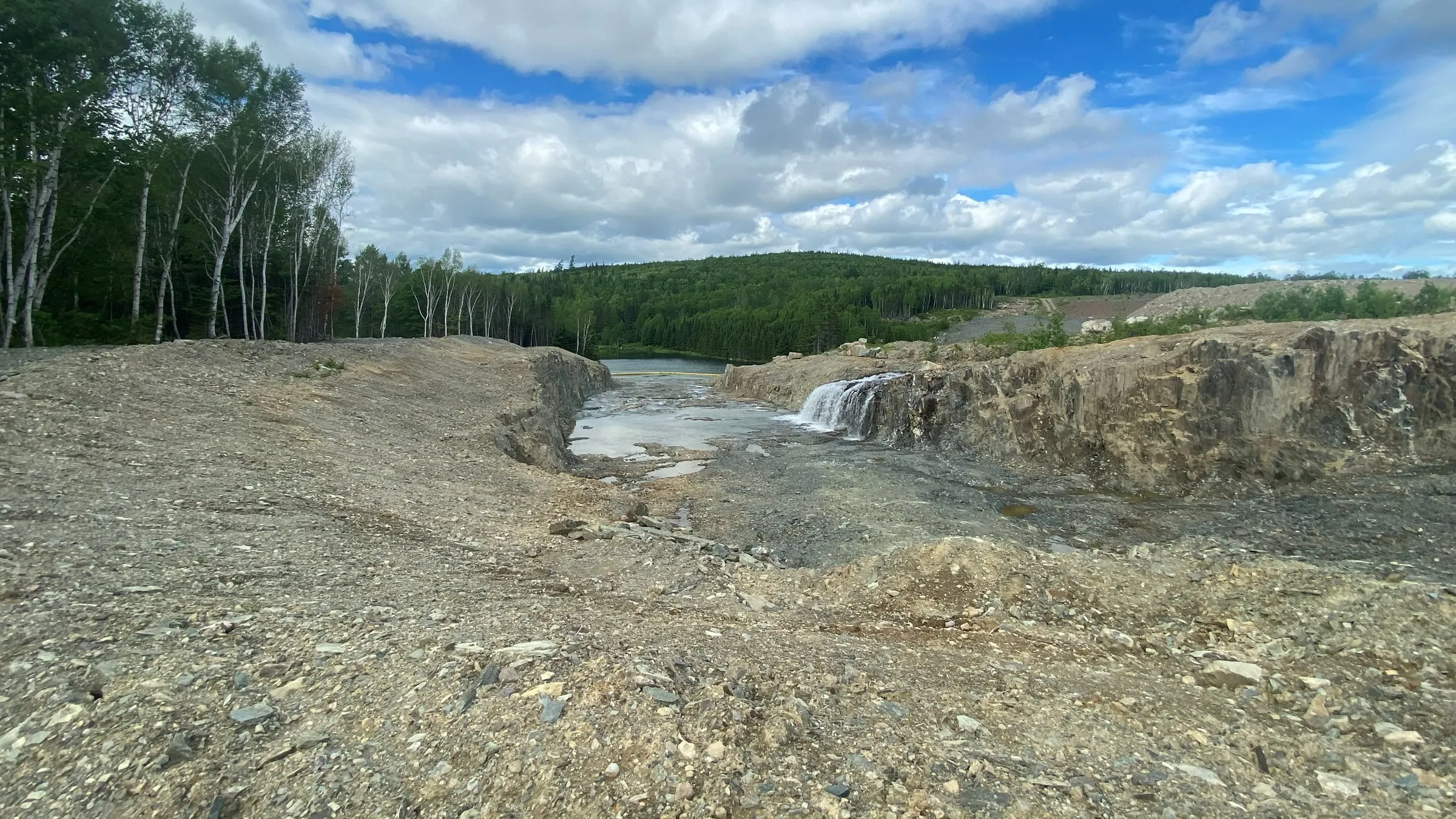
New spillways cut into rock beside a tailings dam and its concrete spillway — 30 blasts under a 25 mm/s limit at the dam, every one independently monitored, the highest reading 37% of the limit.
The Caribou Mine, about 50 km west of Bathurst, is in care and maintenance — but its tailings facility still has to be raised. That meant cutting new service and auxiliary spillways into rock right beside the existing Main Dam and its concrete spillway: structures that cannot be put at risk.
The specification left little room. A 25 mm/s vibration limit within a metre of the dam and spillway structures, no subdrill anywhere near concrete, full blast mats on every shot, and pre-split final walls so the new concrete would sit on sound rock. The plan called for test blasts before production.
The rock was shallow, too, and without subdrill a cartridge-loaded hole tends to leave a hump of rock standing at the toe. So we brought bulk emulsion onto the job with our 1,800 kg mini pumper. Pumped emulsion fills the hole wall to wall and delivers full energy right down at the toe. The shots pulled good floor with no subdrill at all — something packaged product, in the same pattern and hole size, would not have done.
Every one of the 30 blasts was monitored by an independent consultant, with seismographs at the toe and the crest of the dam. The highest reading of the program was 9.2 mm/s — 37% of the limit. Just as important for an earth dam: not one of 171 frequency readings fell below 20 Hz. Low-frequency vibration is what dams are most sensitive to.
That record now does a second job. Regressed into a site-specific attenuation model, it is the design basis for the spillway work at Heath Steele.
Vibration Record
Every blast, against the limit
30 blasts. The highest reading was 9.2 mm/s — 37% of the 25 mm/s limit at the Main Dam. No blast exceeded it.
View as table
| Blast | Vibration (mm/s) | Detail |
|---|---|---|
| Blast 1 — 12 Dec 2025 | 1.77 | 73 Hz · Existing Spillway |
| Blast 2 — 15 Dec 2025 | 4.25 | 45 Hz · Toe of Main Dam |
| Blast 3 — 16 Dec 2025 | 7.1 | 41 Hz · Toe of Main Dam |
| Blast 4 — 17 Dec 2025 | 4.25 | 39.4 Hz · Toe of Main Dam |
| Blast 5 — 18 Dec 2025 | 6.67 | 50 Hz · Toe of Main Dam |
| Blast 6 — 9 Jan 2026 | 8.94 | 32.5 Hz · Toe of Main Dam |
| Blast 7 — 12 Jan 2026 | 8.18 | 30 Hz · Toe of Main Dam |
| Blast 8 — 13 Jan 2026 | 7.54 | 32 Hz · Toe of Main Dam |
| Blast 9 — 14 Jan 2026 | 6.33 | 35.9 Hz · Toe of Main Dam |
| Blast 10 — 15 Jan 2026 | 5.75 | 35.9 Hz · Toe of Main Dam |
| Blast 11 — 16 Jan 2026 | 5.24 | 36.6 Hz · Toe of Main Dam |
| Blast 12 — 19 Jan 2026 | 8.44 | 28.4 Hz · Toe of Main Dam |
| Blast 13 — 20 Jan 2026 | 9.16 | 34.1 Hz · Toe of Main Dam |
| Blast 14 — 21 Jan 2026 | 2.27 | 26 Hz · Crest of Main Dam |
| Blast 15 — 24 Jan 2026 | 6.85 | 38 Hz · Toe of Main Dam |
| Blast 16 — 26 Jan 2026 | 7.47 | 43 Hz · Toe of Main Dam |
| Blast 17 — 28 Jan 2026 | 6.91 | 64 Hz · Toe of Main Dam |
| Blast 18 — 29 Jan 2026 | 3.94 | 38 Hz · Mid-West of Main Dam |
| Blast 19 — 30 Jan 2026 | 7.32 | 73 Hz · Mid-West of Main Dam |
| Blast 20 — 1 Feb 2026 | 6.53 | 54 Hz · Mid-West of Main Dam |
| Blast 21 — 2 Feb 2026 | 7.32 | 79 Hz · Mid-West of Main Dam |
| Blast 22 — 3 Feb 2026 | 5.03 | 37 Hz · Crest of Main Dam (West Side) |
| Blast 23 — 4 Feb 2026 | 3.88 | 39 Hz · Crest of Main Dam (West Side) |
| Blast 24 — 5 Feb 2026 | 2.97 | 39 Hz · Crest of Main Dam (West Side) |
| Blast 25 — 6 Feb 2026 | 3.58 | 32 Hz · Crest of Main Dam (West Side) |
| Blast 26 — 5 Feb 2026 | 3.37 | 51 Hz · Crest of Main Dam (West Side) |
| Blast 27 — 7 Feb 2026 | 2.72 | 51 Hz · Mid-West of Main Dam |
| Blast 28 — 8 Feb 2026 | 1.59 | 37 Hz · Crest of Main Dam (West Side) |
| Blast 29 — 8 Feb 2026 | 1.86 | 34 Hz · Crest of Main Dam (West Side) |
| Blast 30 — 8 Feb 2026 | 1.45 | 47 Hz · Crest of Main Dam (West Side) |
Bulk Emulsion
Loaded with our own emulsion
Shallow rock, a concrete spillway next door and no subdrill allowed. We brought our 1,800 kg mini pumper and loaded the production holes with bulk emulsion. Pumped emulsion fills the hole wall to wall and puts full energy right down at the toe, so the shots still pulled good floor without subdrill. Packaged product in the same pattern and hole size would not have.
How we use emulsion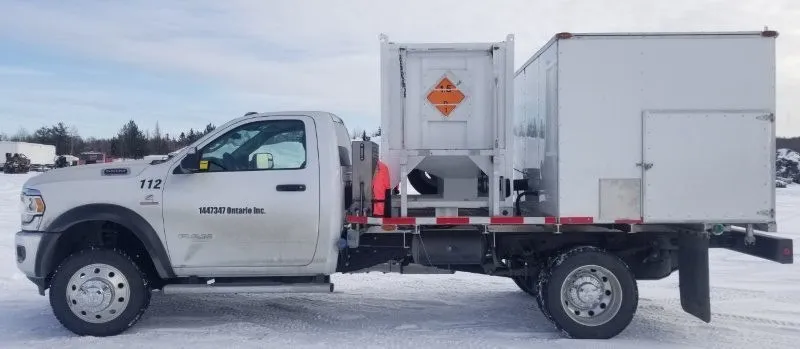
Next Project
Heath Steele Mine — Auxiliary Spillway
A new auxiliary spillway cut through rock near two tailings dams, held to 25 mm/s at the dam — designed from measured vibration data rather than textbook constants, and loaded with metered bulk emulsion.