
- Blasts in September 2026
- 15
- Highest vibration at the dam
- 4.3 mm/s
- Of the 25 mm/s limit, at its peak
- 17%
- Lowest dominant frequency
- 32 Hz
The Work
A new auxiliary spillway cut through rock near two tailings dams, held to 25 mm/s at the dam — designed from measured vibration data rather than textbook constants, and loaded with metered bulk emulsion.
Heath Steele, near Wayerton, is a closed mine with a tailings facility that still has to be maintained. The new auxiliary spillway is cut through rock near both the Main Dam and the Internal Dam, with a hard limit of 25 mm/s within a metre of either.
The usual way to design for a limit like that is a textbook attenuation formula. We didn’t. The blast designs use constants regressed from the measured vibration of 30 monitored blasts at the Caribou tailings dam raise — a directly comparable New Brunswick site — and they design to the 95% upper prediction bound of that data, not its average. The blasting plan was independently reviewed before work began, and a trigger-action plan sets out exactly what happens at 15, 20 and 25 mm/s.
Production holes are loaded with bulk emulsion from our 1,800 kg mini pumper, metered hole by hole. A fully coupled column with a known mass in every hole is what makes charge per delay — and therefore vibration — predictable. It is also what pulls the floor: the rock is shallow and there is no subdrill near the concrete, and pumped emulsion puts full energy at the toe of the hole where packaged product, in the same pattern and hole size, would leave it standing.
Through the first 15 blasts, the highest reading at the dam was 4.3 mm/s, and every blast stayed in the normal operating band.
Vibration Record
Every blast, against the limit
15 blasts. The highest reading was 4.3 mm/s — 17% of the 25 mm/s limit at the Main Dam. No blast exceeded it.
View as table
| Blast | Vibration (mm/s) | Detail |
|---|---|---|
| Blast 1 — 2 Sep 2026 | 1.27 | 51 Hz |
| Blast 2 — 3 Sep 2026 | 1.02 | 57 Hz |
| Blast 3 — 3 Sep 2026 | 0.89 | 39 Hz |
| Blast 4 — 4 Sep 2026 | 2.16 | 32 Hz |
| Blast 5 — 7 Sep 2026 | 1.78 | 39 Hz |
| Blast 6 — 8 Sep 2026 | 3.05 | |
| Blast 7 — 8 Sep 2026 | 3.05 | |
| Blast 8 — 10 Sep 2026 | 1.52 | 43 Hz |
| Blast 9 — 11 Sep 2026 | 1.91 | 73 Hz |
| Blast 10 — 12 Sep 2026 | 3.43 | 57 Hz |
| Blast 11 — 14 Sep 2026 | 4.32 | 43 Hz |
| Blast 12 — 16 Sep 2026 | 1.02 | |
| Blast 13 — 18 Sep 2026 | 1.52 | |
| Blast 14 — 20 Sep 2026 | < 0.5 (no trigger) | |
| Blast 15 — 21 Sep 2026 | < 0.5 (no trigger) |
Bulk Emulsion
Loaded with our own emulsion
Shallow rock, concrete close by and no subdrill allowed. We brought our 1,800 kg mini pumper and loaded every production hole with bulk emulsion. Pumped emulsion fills the hole wall to wall and puts full energy right down at the toe, so the shots still pulled good floor without subdrill. Packaged product in the same pattern and hole size would not have.
How we use emulsion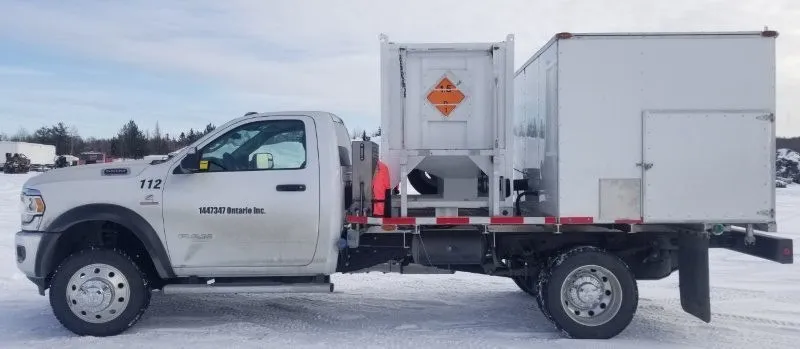
Next Project
Highway 103 Twinning
Mass rock excavation for the twinning of Highway 103 at Chester — 216 blasts since September 2025, loaded with bulk emulsion, beside an open highway and under a 12.5 mm/s limit at the nearest structure.